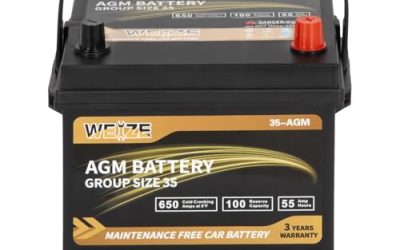
Our Short List of 3

- Group size: 34/78
- Cold cranking amps: 800 CCA
- Capacity: 50 Ah
- Reserve capacity: 100 minutes

- Group size: 34
- Cold cranking amps: 850 CCA
- Capacity: 68 Ah
- Reserve capacity: 135 minutes

- Group size: 34
- Cold cranking amps: 800 CCA
- Capacity: 50 Ah
- Reserve capacity: 100 minutes
All 3 Picks at a Glance
| Product | Specs | Action |
|---|---|---|
| 1. OPTIMA RedTop 34/78 — The Default Hot Rod Battery |
| Check price on Amazon |
| 2. ODYSSEY 34-PC1500T — Maximum Cranking and Cycle Tolerance |
| Check price on Amazon |
| 4. OPTIMA RedTop 34 — The Simple Top-Post Version |
| Check price on Amazon |
Key takeaways
- The best battery for a T-Bucket hot rod: sealed Group 34 and 34/78 AGM picks compared by CCA, mounting flexibility, vibration resistance and dual-purpose use.
As an Amazon Associate we earn from qualifying purchases.
Affiliate Disclosure: This article contains affiliate links to products on Amazon. If you buy through those links, we may earn a commission at no extra cost to you. Every specification below comes from the manufacturer’s published listing data; we have not practical tested these batteries, and you should confirm dimensions and terminal layout against your own battery box before ordering.
A note on what this keyword means: a T-Bucket is a classic hot rod built in the style of a Ford Model T — typically a fibreglass bucket body on a custom chassis, with a small-block V8, minimal weather equipment and very little of anything that is not needed to make it go. There is no factory battery specification for a T-Bucket, because no factory built your car. The builder chose the battery box, the cable runs and often the location — under the seat, behind the seat, in the pickup bed or tucked beside the fuel tank in the rear. So the best battery for a T-Bucket is the one that fits the box you actually have, cranks a V8 that may have high compression and a hungry starter, tolerates vibration in a stiffly sprung car, and survives the long weeks a show car spends sitting still.
For most T-Buckets, that brief points to a sealed AGM battery in Group 34 or the dual-terminal Group 34/78. Group 34 is the size hot rod builders have standardised on for decades: compact enough for a fabricated box, powerful enough for a small-block, and available in spill-proof AGM form that can be mounted on its side, low and out of sight, without venting acid fumes into an open cockpit. The four batteries below are all Group 34-family AGM units, chosen for starting power, mounting freedom and tolerance of an enthusiast car’s irregular life.
Our Picks at a Glance
| Battery | Group | CCA | Reserve capacity | Best for |
|---|---|---|---|---|
| OPTIMA RedTop 34/78 | 34/78 | 800 | 100 minutes | Most T-Buckets; dual top and side terminals |
| ODYSSEY 34-PC1500T | 34 | 850 | 135 minutes | Maximum cranking and deep-cycle tolerance |
| OPTIMA YellowTop D34/78 | 34/78 | 750 | 120 minutes | Cars with big stereos or accessories, engine off |
| OPTIMA RedTop 34 | 34 | 800 | 100 minutes | Simple top-post-only installations |
What a T-Bucket Actually Asks of a Battery
Cranking a V8, often a modified one. A stock small-block is easy to turn over. A high-compression build with a high-torque starter, thick oil on a cold morning and timing dialled in for power is not. Every pick here delivers 750 CCA or more, which is generous headroom for a small-block and adequate for most big-block buckets as well.
Vibration, constantly. A T-Bucket has a rigid or stiffly sprung chassis, solid engine mounts in many builds, and a battery box that is often bolted straight to the frame. Vibration is the quiet killer of conventional flooded batteries, whose plates shed material with every shake. AGM construction, with the plates held in compression, is the standard answer, and the spiral-cell and pure-lead designs below are built specifically around surviving it.
Long rests between drives. Most T-Buckets are fair-weather cars. They sit for weeks, sometimes a whole winter. That punishes a battery two ways: self-discharge drains it slowly, and the parasitic draw of a modern stereo memory, an alarm or an electric fan controller drains it faster. Sealed AGM batteries self-discharge more slowly than flooded ones, and a battery maintainer over winter is the single cheapest life-extender you can buy for any of them.
No room, and no forgiveness for leaks. In an open car, the battery often lives inches from upholstery, paint or the driver. A flooded battery that vents or tips is a genuine problem. Every battery here is sealed and spill proof, and can be mounted in positions a flooded battery cannot — which is why AGM is effectively the default for this hobby.
1. OPTIMA RedTop 34/78 — The Default Hot Rod Battery
- Group size: 34/78
- Cold cranking amps: 800 CCA
- Capacity: 50 Ah
- Reserve capacity: 100 minutes
If one battery defines the T-Bucket engine bay — or, more often, the T-Bucket battery box — it is this one. OPTIMA’s own listing describes the 34/78 RedTop as built for heavy use by hot rods and off-roaders, and the reasons are practical rather than nostalgic. The dual-terminal layout is the first: a T-Bucket’s wiring is custom, and having both top posts and side terminals on the same case means the starter cable, the main feed and an accessory take-off do not have to fight for one post. Builders routinely use the side terminals for the starter and the top posts for the rest of the car, or the reverse, whichever keeps the runs cleaner.
The second reason is the case. The SpiralCell construction — lead plates wound into six cylindrical cells — produces a sealed battery that OPTIMA rates at many times the vibration resistance of a standard flooded battery, that cannot spill, and that can be mounted in almost any position. In a bucket where the battery may sit on its side under a seat or low in the frame rails, that freedom decides the installation.
The RedTop is a pure starting battery. It is made to deliver a hard burst — 800 CCA here — and then be recharged by the alternator. It is not the choice if you plan to run lights and a stereo for hours with the engine off; that is the YellowTop’s job, below. For the way most T-Buckets are actually used — driven to a show, parked, driven home — starting power and shelf life are what matter, and this is the benchmark.
2. ODYSSEY 34-PC1500T — Maximum Cranking and Cycle Tolerance
- Group size: 34
- Cold cranking amps: 850 CCA
- Capacity: 68 Ah
- Reserve capacity: 135 minutes
The ODYSSEY 34-PC1500T is the heavy-duty alternative, built on thin-plate pure lead (TPPL) technology. Because its plates are made of pure lead rather than a lead alloy, the manufacturer can fit more of them into the same Group 34 case, and the published figures show it: 850 CCA, a 68 Ah capacity and 135 minutes of reserve — all higher than the RedTop’s, in a case measuring 10.85 by 6.76 by 7.82 inches and weighing 49.5 pounds.
The other half of the ODYSSEY proposition is cycle tolerance. The maker rates this battery for up to 400 cycles at deep discharge, which in T-Bucket terms means it forgives the abuse that kills lesser batteries: the winter it sat half-charged, the show day the electric fan ran the battery down, the month the maintainer was unplugged. For a car that is driven irregularly and stored casually, that tolerance is worth more than a headline CCA figure.
The trade-offs are weight and simplicity. At just under 50 pounds it is the heaviest battery here — noticeable in a car whose whole charm is lightness — and it offers top posts only, so a build wired for side terminals will need its cables reworked. It also carries a limited full-replacement warranty of up to four years per the listing, the longest stated cover in this group. Choose it if your bucket has a high-compression engine, a history of eating batteries, or both.
3. OPTIMA YellowTop D34/78 — For Buckets That Run Accessories Engine-Off
- Group size: 34/78
- Cold cranking amps: 750 CCA
- Type: Dual purpose — starting and deep cycle
- Terminals: Dual — SAE top posts plus GM-style side terminals
- Manufacturer part number: 8014-045
Some T-Buckets are bare bones. Others carry a serious stereo, air suspension, electric fans, a winch on the matching trailer, or lighting that runs at evening shows with the engine silent. That pattern — real electrical load with the engine off — is deep cycling, and it is exactly what a starting battery is not built for. The YellowTop D34/78 is OPTIMA’s dual-purpose answer in the same 34/78 case as our top pick: 750 CCA for starting, plus plates designed to be discharged and recharged repeatedly without the rapid damage a RedTop would suffer.
The 50 CCA you give up against the RedTop is irrelevant for a small-block in a light car; 750 CCA turns one over with ease. What you gain is a battery that tolerates the show-field pattern of short drive, long accessory session, short drive home. It keeps the dual terminals and the sealed, mount-anywhere case, so it drops into the same battery boxes as the RedTop.
Be honest about your car before paying the dual-purpose premium. If your bucket has no stereo, no air ride and a mechanical fan, the YellowTop’s cycling ability will never be used and the RedTop is the better buy. If the car regularly powers anything with the engine off, this is the correct battery and the starting-only picks are the false economy.
4. OPTIMA RedTop 34 — The Simple Top-Post Version
- Group size: 34
- Cold cranking amps: 800 CCA
- Capacity: 50 Ah
- Reserve capacity: 100 minutes
The RedTop 34 is the same starting battery as our top pick — same 800 CCA, same SpiralCell AGM construction, same 50 Ah and 100-minute reserve — in a case with top posts only. It exists for builds whose wiring is already finished around top terminals and whose battery box was fabricated for the plain Group 34 footprint without the side-terminal bosses.
Choosing between this and the 34/78 is purely a wiring decision. If your cables are top-post and you have no plan to add accessory feeds, this version keeps the installation exactly as the builder made it. If there is any chance you will add a feed for an electric fan, a stereo or a battery maintainer pigtail later, the dual-terminal 34/78 gives you somewhere clean to land it. Either way, measure your box: the Group 34 case is roughly 10 by 6.9 by 7.8 inches, and fabricated boxes are sometimes built tight around one specific battery, including its terminal height.
Fitting a Battery in a T-Bucket: Practical Notes
Measure the box, not the catalogue. There is no standard T-Bucket battery location. Measure the internal length, width and height of your box, note which side the cables enter from, and check terminal clearance with the lid or seat base closed. A battery that fits with the seat removed but fouls the seat frame is a battery that does not fit.
Secure it like it matters, because it does. A battery of 40 to 50 pounds in a light car becomes a serious projectile in a collision, and a loose battery also chafes cables and cracks cases. Use a proper hold-down — a strap or clamp that holds the case at its base — not a bungee cord. If your box has no hold-down, fabricating one is a small job that protects everything around the battery.
Mind the cable gauge and the earth. Long cable runs from a rear-mounted battery to a front starter need heavy cable; undersized cable is a common cause of the slow, groaning crank that owners blame on the battery. The earth strap deserves the same attention: run it to the engine block or a clean, bare-metal chassis point, and keep the connections bright and tight.
Ventilation and heat. Sealed AGM batteries do not vent under normal charging, which is why they can live in the cockpit — but no battery enjoys heat. A box hard against an exhaust run will cook any of these batteries early. If your only location is a hot one, a heat shield between exhaust and box is cheap insurance.
Storage. For winter, the routine is simple: charge the battery fully, keep it on an AGM-compatible maintainer, and store the car with the battery connected to the maintainer or disconnected entirely. A battery left discharged in a cold garage sulphates; a battery kept charged lasts for years. All four batteries here are AGM, so confirm your maintainer has an AGM mode — an old flooded-only charger can undercharge or overcharge them.
Frequently Asked Questions
What size battery does a T-Bucket use?
There is no factory size, because every T-Bucket is individually built. Group 34 and Group 34/78 AGM batteries are the hobby’s default: compact, powerful enough for a V8, and sealed for flexible mounting. Measure your battery box and match the case and terminals to it.
Can I mount the battery on its side?
With a sealed AGM battery, yes — all four batteries here are spill proof and can be mounted in positions a flooded battery cannot. That freedom is one of the main reasons AGM dominates this hobby.
Starting battery or dual purpose — which does my car need?
If the battery only starts the engine and runs the car while driving, a starting battery such as the RedTop is right. If you run a stereo, air suspension or lighting with the engine off, choose the dual-purpose YellowTop.
Why does my T-Bucket keep killing batteries?
Usually a combination of long storage without a maintainer, vibration in a rigidly mounted box, and an undersized or poorly earthed cable run making every start a deep event. An AGM battery, a maintainer and clean, heavy cables solve most cases.
The Bottom Line
For most T-Buckets, the OPTIMA RedTop 34/78 is the answer: 800 CCA, dual terminals for custom wiring, and a sealed case that mounts anywhere and shrugs off vibration. Step up to the ODYSSEY 34-PC1500T if your car has a high-compression engine or a habit of flattening batteries in storage. Choose the YellowTop D34/78 if the car powers accessories with the engine off, and the plain RedTop 34 if your build is wired for top posts only. Whatever you choose, measure the box first — on a hand-built car, the tape measure is the fitment guide.