Key takeaways
- Ceiling fans vs standing fans compared on airflow, installation, space, and noise, with five spec-checked picks to help you cool the right room.
- Top Pick: Ceiling fans vs standing fans at a glance
- Runner-up: Ceiling fans vs standing fans at a glance
- Also consider: Ceiling fans vs standing fans at a glance
Ceiling fans and standing fans solve the same problem in opposite ways. A ceiling fan is a permanent fixture that moves air across a whole room from above, while a standing fan is a portable appliance you aim at the spot where you are sitting. If the room is yours to change and you want even, whole-room circulation every day, a ceiling fan is usually the better long-term answer. If you rent, move between rooms, or only need a breeze on the warmest afternoons, a standing fan gives you that flexibility for far less effort.
As an Amazon Associate, we earn from qualifying purchases.
Contents
- Quick verdict
- Ceiling fans vs standing fans at a glance
- The key differences
- Ceiling fan picks
- Standing fan picks
- Who should choose a ceiling fan
- Who should choose a standing fan
- FAQ
- Conclusion
Quick verdict
Choose a ceiling fan if the room has a suitable ceiling outlet box, you plan to stay in the home, and you want quiet, even airflow that also works alongside a light fixture. Choose a standing fan if you cannot modify the room, you want cooling you can carry from the living room to the bedroom, or you need targeted airflow at a desk, sofa, or bed rather than circulation for the whole space. Many households end up with both: a ceiling fan in the main living area and a standing fan that follows people around.
Ceiling fans vs standing fans at a glance
| Factor | Ceiling fan | Standing fan |
|---|---|---|
| Airflow pattern | Broad, whole-room circulation from above | Focused stream aimed at one area |
| Installation | Hardwired into a ceiling outlet box | None; plug in and use |
| Floor space used | None | A footprint roughly the size of the base |
| Portability | Fixed in one room | Moves room to room |
| Direction control | Reversible motor for summer and winter use | Oscillation and tilt head |
| Lighting | Many models include a light kit | No lighting function |
| Controls | Pull chain, wall switch, or remote | On-unit buttons or remote |
| Best for | Living rooms, bedrooms, dining rooms | Renters, guest rooms, desks, temporary setups |


The key differences
Airflow and coverage
A ceiling fan pushes air downward across the full width of its blade span, so a 52-inch model stirs the air in the whole room rather than in one corner. That makes the cooling effect feel even: everyone in the room gets some moving air, and the fan also helps distribute air from a heater or air conditioner. A standing fan concentrates its output into a narrower stream. Within that stream the breeze feels stronger and more direct, which is exactly what you want when you are sitting at a desk or in bed, but someone across the room may feel very little of it.
Installation and permanence
This is the biggest practical divide. A ceiling fan replaces a ceiling light fitting or mounts to a fan-rated outlet box, and it involves wiring, a ladder, and either a confident DIY installer or an electrician. Once fitted, it stays with the house. A standing fan needs no installation at all: assemble the base and pole, plug it in, and it is running in minutes. For renters and anyone in a short-term home, that difference alone usually settles the question.
Space and placement
A ceiling fan uses no floor or surface space, which matters in small rooms where every corner is spoken for. It does need adequate ceiling height, though: blades should sit well above head height, and low-profile mounts exist for rooms where a downrod would hang too low. A standing fan needs a stable patch of floor and enough clearance for its oscillation sweep, and its height adjustment only helps if there is room to position it where the airflow can reach you.
Controls and extra features
Ceiling fans are controlled by a pull chain, a wall switch, or a handheld remote, and many models double as the room’s main light, which saves fitting a separate fixture. Reversible motors let the fan run in the opposite direction in winter to push warm air down from the ceiling. Standing fans answer with oscillation, tilt heads, timers that switch the fan off after you fall asleep, and remotes on many models. Neither type is complicated, but the standing fan’s features are all about directing air at a person, while the ceiling fan’s features are about conditioning a room.
Noise and everyday use
Because a ceiling fan is fixed overhead and runs at relatively low blade speeds for its size, it tends to fade into the background, which suits bedrooms and living rooms. A standing fan sits closer to ear level and its motor and blades are nearer to you, so speed changes are more noticeable; models with DC motors and many speed settings give finer, quieter low-speed control for overnight use. In both cases, the published speed settings and motor type in the listing tell you more than any general claim, so check the specs of the exact model.
Ceiling fan picks
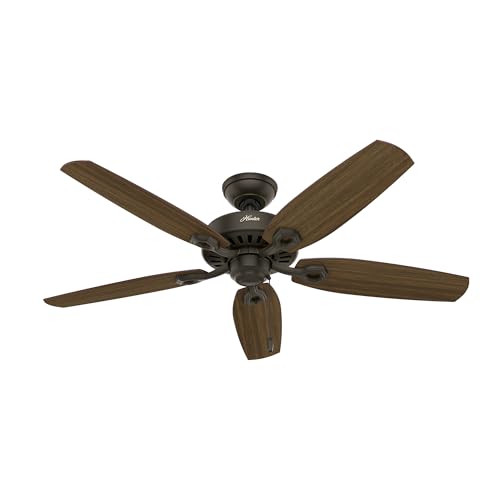
Hunter Builder Elite 53242, 52-Inch Ceiling Fan (budget tier)
A straightforward, no-light ceiling fan for rooms that already have good lighting. The 52-inch span and five blades suit medium to large rooms, and the pull chain keeps control simple with no remote to lose. The low overall height of just over 11 inches with the included standard mount makes it a sensible pick where ceiling height is limited.
Specs:
- Brand and model: Hunter Builder Elite 53242
- Blade span: 52 inches, 5 blades
- Light kit: none
- Control: pull chain
- Mounting: standard mount
- Dimensions: 52 x 52 x 11.27 inches
- Finish: New Bronze
Hunter Pro’s Best 53250, 52-Inch Ceiling Fan with LED Light Kit (mid-range tier)
This model adds an integrated LED light kit to the same 52-inch format, so one ceiling fitting handles both air movement and the room’s main lighting. Pull chain control keeps it simple, and the taller profile leaves room for the light kit housing. It fits buyers who are replacing an old ceiling light and want the fan and light in a single unit.
Specs:
- Brand and model: Hunter Pro’s Best 53250
- Blade span: 52 inches
- Light kit: LED light kit included
- Control: pull chain
- Dimensions: 52 x 52 x 15.6 inches
- Finish: New Bronze
Hunter Bennett 54190, 52-Inch Ceiling Fan with LED Light and Remote (premium tier)
The Bennett steps up to remote control, so speed and light can be adjusted from the sofa or bed without a wall switch upgrade. Its low-profile design is made for rooms where a hanging fan would sit too low, and the LED light kit covers general room lighting. This is the ceiling fan pick for a main living room or bedroom where convenience matters as much as airflow.
Specs:
- Brand and model: Hunter Bennett 54190
- Blade span: 52 inches, 5 blades
- Light kit: LED light included
- Control: remote control included
- Mounting: low profile
- Dimensions: 52 x 52 x 18.82 inches
- Finish: brushed nickel
- Listed features: LED light, quiet operation, remote control
Standing fan picks
Lasko Cyclone 1885, 18-Inch Pedestal Fan (mid-range tier)
A full-size pedestal fan with an 18-inch blade, three speeds, and a remote control, so it can be adjusted from across the room. The stand adjusts up to 54 inches tall, the head tilts back, and widespread oscillation spreads the breeze across a seating area rather than a single chair. A built-in timer lets it switch itself off, which suits overnight use in a bedroom.
Specs:
- Brand and model: Lasko Cyclone 1885
- Blade size: 18 inches
- Speeds: 3
- Control: remote control included
- Timer: yes, auto-off
- Oscillation: widespread
- Height: adjustable, up to 54 inches
- Dimensions: 20.2 x 20.2 x 54 inches
- Color: white
PELONIS PFS40D6ABB, 16-Inch Pedestal Fan with DC Motor (premium tier)
This PELONIS model uses a DC motor with 12 speed settings, giving much finer control than a typical three-speed fan, including very low speeds for sleeping. It pairs that with 90-degree oscillation, a 12-hour timer, remote control, and adjustable height in a compact 16-inch format. It suits light sleepers and anyone who wants a standing fan that can run quietly all night and harder during the day.
Specs:
- Brand and model: PELONIS PFS40D6ABB
- Blade size: 16 inches
- Motor type: DC motor
- Speeds: 12
- Timer: 12-hour
- Oscillation: 90 degrees
- Control: remote control included
- Height: adjustable
- Color: black
Who should choose a ceiling fan
Choose a ceiling fan if you own your home or have permission to change the fitting, the room has a suitable ceiling box, and you want one appliance to circulate air for everyone in the room. Ceiling fans also make sense where floor space is tight, where the fan will run daily for long stretches, and where combining the fan with the room’s main light simplifies things. If you want gentle background air movement in a bedroom every night of the summer, the ceiling fan is the set-and-forget option.
Who should choose a standing fan
Choose a standing fan if you rent, if the ceiling is too low or unsuitable for a fixture, or if the need for cooling moves with you between rooms. Standing fans are also the better tool when one person wants a direct breeze at a desk, sofa, or bed while the rest of the room stays as it is. Because there is no installation, a standing fan is also the right answer for guest rooms, dorms, and short heat waves where a permanent fitting is hard to justify.
FAQ
Can a ceiling fan replace air conditioning?
No. A ceiling fan moves air, and moving air makes people feel cooler, but it does not lower the room’s temperature. It can let you run air conditioning less or set it a little warmer, and it helps spread cooled air around the room, but on its own it is a comfort aid rather than a cooling system.
How big should a ceiling fan be for a living room?
Blade span is the figure to match to the room. A 52-inch fan like the three picks above is the standard choice for medium to large living rooms and bedrooms. Smaller rooms can use a smaller span, and very large or open-plan spaces may need a larger fan or more than one.
Are standing fans good for sleeping?
Yes, provided the noise at low speed suits you. Look for a model with several speed settings or a DC motor, a timer so the fan can switch off during the night, and oscillation so the breeze is not fixed on one spot. The PELONIS pick above is built around exactly that use, with 12 speeds and a 12-hour timer.
Do ceiling fans work in winter as well?
Many do. Ceiling fans with reversible motors can run in the opposite direction at low speed, pushing warm air that collects near the ceiling back down into the room. Check the listing of the model you are considering for a reversible motor if winter use matters to you, and confirm the control type, since reversing is done by a switch on the motor housing or by the remote on some models.
Conclusion
Ceiling fans vs standing fans is really a question about the room, not the fan. A ceiling fan is a permanent, whole-room solution that disappears into the ceiling and can carry the room’s lighting too; the Hunter picks above cover a simple no-light model, a mid-range fan with an LED kit, and a remote-controlled low-profile option. A standing fan is the flexible, no-installation answer that follows you around the house, and the Lasko and PELONIS picks show the range from a classic three-speed pedestal to a quiet DC-motor model with 12 speeds. Match the type to how long you will stay, whether you can fit a ceiling fixture, and whether you need the whole room cooled or just your chair.