Key takeaways
- Table runner vs placemats compared on coverage, protection, care and styling, with five product picks to help you choose the right table linen setup.
A bare dining table rarely looks finished, and it rarely survives daily meals unmarked. Table runners and placemats are the two classic answers to that problem, and they solve it in opposite ways. A runner is one long strip of fabric laid down the center of the table, while placemats are individual mats placed at each seat. Both protect the surface and add color and texture, but they differ in coverage, upkeep, and the kind of look they create.
Choosing between them comes down to how you actually use your table. If your table doubles as a workspace, homework station, and dining surface, individual mats you can lift away in seconds may suit you better. If you love a styled centerpiece and a polished, layered table, a runner is hard to beat. Many households end up owning both and swapping them by occasion. This guide compares the two formats head to head and then recommends five real products — three runners and two placemat sets — across budget, mid-range, and premium tiers.
As an Amazon Associate, we earn from qualifying purchases.
Table of Contents
- What a Table Runner Does
- What Placemats Do
- Head to Head: Coverage and Protection
- Head to Head: Look and Styling
- Head to Head: Care and Laundry
- Head to Head: Guests, Kids, and Everyday Mess
- The 5 Products Compared
- How to Choose Between a Runner and Placemats
- Frequently Asked Questions
- Conclusion
- Product and ASIN Reference
What a Table Runner Does
A table runner is a narrow length of fabric, typically 12 to 18 inches wide and anywhere from 72 to 120 inches long, designed to run down the middle of the table with a short drop over each end. It protects the center strip of the tabletop — the zone where hot serving dishes, vases, and candleholders usually land — while leaving the wood or finish visible along both sides. Because it is a single piece, a runner also acts as a visual anchor: it gives centerpieces a defined stage and ties the whole setting together with one color or pattern.
Runners are usually made from natural or blended fabrics such as cotton, linen, or polyester poplin. They fold or roll up small, so storage is easy, and most are machine washable. The trade-off is that a runner does nothing for the areas in front of each diner, which is exactly where plates, cutlery, and glasses sit and where most spills happen.
What Placemats Do
Placemats are individual mats, most often rectangular at about 12 by 18 inches or round at about 15 inches across, placed one per seat. Each mat defines a personal dining zone and catches the crumbs, drips, and heat marks that come with a place setting. Because they sit under the plate, they protect the part of the table that takes the most daily punishment.
Placemats come in a wider range of materials than runners: woven vinyl, leather and faux leather, cotton, linen, bamboo, cork, and silicone. Woven vinyl styles are especially popular for everyday family use because they wipe clean in seconds and need no laundry. The trade-off is visual: a set of mats protects the seats but leaves the center of the table exposed, and a table set with mats alone can look plainer than one dressed with a runner unless you add a centerpiece.
Head to Head: Coverage and Protection
For raw surface protection, placemats win at the seats and runners win at the center. A placemat shields the table from hot plates, condensation rings, and knife-and-fork scratches right where each person eats. A runner shields the middle, which matters if you serve family-style from shared dishes set directly on the table. Neither format covers the whole table the way a tablecloth does. If full coverage is your priority, layer them: a runner down the center plus a mat at each seat is a common combination in styled dining rooms, and the two products in this guide pair well together for exactly that reason.
One honest limitation of woven vinyl placemats is that an open weave lets liquid seep through slowly, so a large spill still needs a quick wipe underneath. Fabric runners absorb small drips but can stain, which is why washable fabrics matter on the runner side.
Head to Head: Look and Styling
A runner reads as decor first. It introduces pattern, fringe, tassels, or embroidery along the table’s spine and photographs beautifully for holidays and dinner parties. Placemats read as function first, though coordinated sets in a textured weave or a leather finish can look sharp and modern. If your table itself is the statement piece — a reclaimed wood farmhouse table, for example — a runner shows off more of it than a tablecloth while still dressing the middle. If you prefer a clean, minimal table between meals, placemats stack in a drawer and disappear, while a runner left in place becomes part of the room’s permanent look.
Head to Head: Care and Laundry
Woven vinyl placemats are the lowest-maintenance option in this comparison: shake off crumbs, wipe with a damp cloth, and they are ready for the next meal. Fabric placemats and fabric runners both go in the wash, but a runner is one item per load instead of six, and long runners can need ironing to lie flat and crisp. Linen runners wrinkle by nature — many people like the relaxed look, but if you want a pressed finish every time, a polyester poplin runner or a vinyl mat will save you effort.
Head to Head: Guests, Kids, and Everyday Mess
For households with children, placemats are the practical pick. Each child gets a defined space, spills stay mostly on one washable mat, and you can add or remove seats without redressing the whole table. For dinner parties, a runner sets the scene and gives you a natural home for candles and serving boards. For everyday adult dining, it comes down to habit: people who clear and wipe the table after every meal often prefer mats, while people who leave the table dressed between meals often prefer a runner.
The 5 Products Compared
1. Maison d’ Hermine Table Runner, Equinoxe Beige — Premium Runner

Maison d’ Hermine is known for printed cotton table linens, and this single-layer runner in the Equinoxe Beige design is the premium pick here. It is made from pure cotton, measures 14.5 by 108 inches, and carries OEKO-TEX Standard 100 certification, which means its components have been tested against a list of regulated and unregulated chemicals. The long 108-inch length suits larger dining tables and leaves a generous drop at both ends.
Specs:
- Material: Cotton, single layer
- Size: 14.5 x 108 inches
- Design: Equinoxe, Beige
- Certification: OEKO-TEX Standard 100
- Tier: Premium
2. Over&Back Washed Linen Table Runner, Grey — Mid-Range Runner
This runner from over&back is cut from pure linen with a washed finish that gives it a soft, relaxed drape straight out of the packet. At 18 inches wide it is broader than most runners, so it covers more of the table’s center, and the 90-inch length fits standard six-seat tables well. The grey colorway is neutral enough for everyday use and easy to pair with white or patterned placemats layered on top.
Specs:
- Material: Linen
- Size: 18 x 90 inches
- Color: Grey
- Model number: TL-RNR-203147
- Tier: Mid-range
3. LA Linen Polyester Poplin Table Runner, Khaki — Budget Runner

LA Linen’s poplin runner is the straightforward budget option: a smooth polyester runner in a versatile khaki shade, sized 14 by 108 inches for longer tables. Polyester poplin resists wrinkles better than natural fibers and holds up to frequent washing, which makes it a sensible pick for everyday family dining and for events where you need several matching runners. It is a plain, no-fuss design, so it works best as a base under bolder centerpieces or patterned dinnerware.
Specs:
- Material: Polyester poplin
- Size: 14 x 108 inches
- Color: Khaki
- Brand: LA Linen
- Tier: Budget
4. DECKALY Placemats Set of 6, Grey — Mid-Range Placemats

DECKALY’s woven placemats are made from PVC vinyl in a tight cross-weave that looks like fabric but behaves like plastic: heat resistant, non-slip, and washable with a simple wipe or rinse. Each mat measures 18 by 12 inches, the standard rectangular place-setting size, and the set of six covers a full family table. The grey colorway hides everyday marks well. Note that the open weave means spilled liquid can seep through slowly, so lift and wipe under the mat after a big spill.
Specs:
- Material: PVC (vinyl), woven
- Size: 18 x 12 inches per mat
- Set size: 6 placemats
- Color: Grey
- Tier: Mid-range
5. Uolr Placemats Set of 6, Grey — Budget Placemats
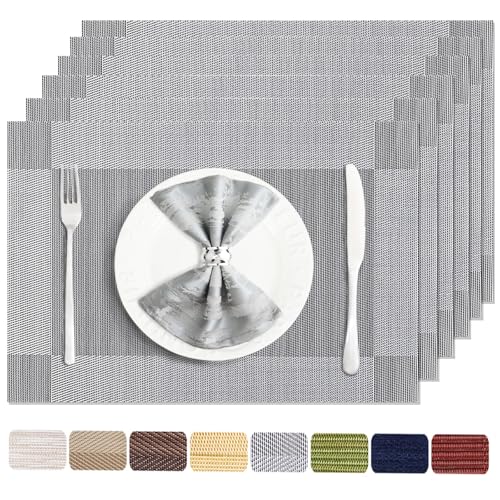
The Uolr set covers the same ground as the DECKALY at a budget tier: six woven vinyl placemats in grey, each 12 by 18 inches, that are washable, wipeable, heat resistant, and non-slip. They are suitable for indoor dining tables and outdoor patio tables alike, and the woven texture keeps plates and glasses from sliding. Like most woven vinyl mats, they do not absorb water, so spills sit on the surface until wiped — easy cleanup, but wipe promptly on wood tables.
Specs:
- Material: Vinyl, woven
- Size: 12 x 18 inches per mat
- Set size: 6 placemats
- Color: Grey
- Tier: Budget
How to Choose Between a Runner and Placemats
Start with the mess. If most of your table wear happens at the seats — kids, daily family meals, hot plates straight from the stove — choose placemats. If most of it happens in the middle — serving dishes, centerpieces, candles — choose a runner. Next, think about laundry. One runner is one item to wash and iron; six fabric placemats are six. Woven vinyl mats skip laundry entirely. Then measure: a runner should hang roughly 6 to 12 inches over each end of the table, so add 12 to 24 inches to your table length when choosing a size. Placemats should be wide enough to hold a full setting, which is why 12 by 18 inches is the standard. Finally, consider buying both formats in coordinating colors if you entertain often — the layered look is the most finished of all, and each piece still works on its own for daily use.
Frequently Asked Questions
Can you use a table runner and placemats together?
Yes. Layering a runner down the center with a placemat at each seat is a standard styling combination. The runner dresses the middle of the table while the mats protect each place setting, and the two together give more coverage than either one alone.
What size table runner do I need for a 72-inch table?
Look for a runner between 84 and 96 inches long, which leaves about 6 to 12 inches of overhang at each end. A 108-inch runner like the Maison d’ Hermine and LA Linen picks above will drop further, which suits a more formal look, while the 90-inch over&back runner sits right in the ideal range for a 72-inch table.
Are woven vinyl placemats heat resistant?
Yes, woven vinyl placemats are made to shield the table from warm plates and serving dishes, and both sets in this guide are described as heat resistant by their makers. They are not trivets, though — a dish straight from a hot oven should still go on a proper heat pad rather than directly on any placemat.
How do you clean fabric table runners?
Cotton and linen runners are generally machine washable on a gentle cycle and benefit from a warm iron if you want a crisp finish. Polyester poplin runners like the LA Linen pick resist wrinkles and need little or no ironing. Always check the care label on the specific product, since printed and embroidered designs can have their own instructions.
Conclusion
Neither format is universally better — they protect different parts of the table and create different looks. Choose placemats if your priority is per-seat protection and the fastest possible cleanup, especially with kids at the table. Choose a runner if your priority is style, centerpieces, and protecting the middle of the table where serving dishes land. If you entertain regularly, owning one of each is the most flexible answer. Of the picks above, the Maison d’ Hermine runner is the premium statement piece, the over&back linen runner is the relaxed everyday option, and the DECKALY and Uolr sets make daily placemat use about as low-effort as it gets.