Key takeaways
- Ottoman vs pouf compared on structure, storage, height and style, with five real picks to help you choose flexible seating for your living room.
Ottomans and poufs sit side by side in the same furniture aisle and do many of the same jobs: both prop up feet, both work as overflow seating, and both can stand in for a coffee table in a pinch. The difference is construction. An ottoman is a piece of framed furniture, an upholstered box or bench built around wood or engineered-wood panels, often with a hinged or lift-off lid and storage inside. A pouf is a soft, frameless cushion, a fabric shell filled with foam, beads, or fiber that has no rigid structure at all.
That one difference drives everything else. The ottoman’s frame makes it firmer, taller, and better as a seat or a table surface, and it can hide blankets and remotes inside. The pouf’s soft fill makes it lighter, squishier, and easier to toss into a corner, carry to another room, or hand to a child as a floor seat. Below, we compare the two styles on structure, storage, size, and care, then look at five real products, three ottomans and two poufs, so you can match the format to the way your room actually gets used.
As an Amazon Associate, we earn from qualifying purchases.
Table of Contents
- Ottoman vs Pouf at a Glance
- What Is an Ottoman?
- What Is a Pouf?
- Structure, Storage, and Everyday Use
- The 5 Products Compared
- How to Choose Between an Ottoman and a Pouf
- Who Should Skip Each One
- Frequently Asked Questions
- Conclusion
Ottoman vs Pouf at a Glance
| Feature | Ottoman | Pouf |
|---|---|---|
| Construction | Framed box or bench, usually wood or MDF panels | Frameless fabric shell with soft fill |
| Storage | Often, inside a hollow body under a lid | None, the fill takes the whole interior |
| Typical height | About 15 to 18 inches | About 10 to 16 inches |
| Firmness | Firm and stable, holds a tray or a seated adult | Soft and yielding, molds to your legs |
| Weight | Heavier, roughly 6 to 25 lb | Very light, easy to carry one-handed |
| Best for | Storage, coffee-table duty, structured seating | Casual floor seating, footrest, kids’ rooms, boho texture |
The short version: buy an ottoman when you want furniture that stores things and holds a steady surface. Buy a pouf when you want a soft accent you can move around freely.
What Is an Ottoman?
An ottoman is an upholstered piece of furniture built around a frame. Storage ottomans are hollow boxes with padded lids, and they come in three common shapes: long benches that seat two and sit at the foot of a bed or in an entryway, cubes that work as a single footrest or side seat, and round drums that double as coffee tables. Because the body is rigid, an ottoman keeps clean lines and presents a flat top that holds a tray, a laptop, or a board game without wobbling.
The frame also sets the ottoman’s limits. It weighs more than a pouf, it does not squeeze into odd corners, and folding models need a minute of assembly before first use. In exchange, you get the only real storage in this comparison, plus a seat height that usually matches sofa seat height, so sitting down and standing up feel natural for adults and older guests.
What Is a Pouf?
A pouf is a large, firm cushion with no frame, legs, or lid. The shell is usually a woven or knitted textile, jute, cotton, or faux leather, and the inside is filled with expanded polystyrene beads, shredded foam, or polyester fiber. It holds its shape through the fill alone, which is why a pouf feels soft when you rest your feet on it and gives slightly when someone sits down.
Poufs are the more casual, portable option. Most weigh only a few pounds, so they migrate around the room: footrest at the sofa, extra seat when guests arrive, floor cushion for kids. They also bring texture that framed furniture rarely does, since knitted and woven shells read as decor in their own right. The trade-offs are no storage, a lower and softer seat, and fill that can compress over time, so a pouf used daily as a primary seat will gradually sit lower than it did when new.
Structure, Storage, and Everyday Use
Structure and support. An ottoman’s panels spread weight across a frame, and storage models in this comparison carry stated static load capacities far beyond what a footrest needs, which is why they double as reliable extra seating. A pouf supports weight by displacing fill, so it feels stable enough for sitting but softer at the edges, and perching on the side can make it roll or slump.
Storage. This is the clearest split. Every ottoman below has a hollow interior, from a small cube that swallows a throw blanket to a long bench that holds bedding or board games. A pouf has no interior at all, so if clutter control is part of the purchase, the pouf cannot help.
Height and posture. Ottomans usually stand 15 to 18 inches tall, close to sofa seat height, so your knees stay near a right angle with your feet up. Poufs range from low, wide cushions around 10 inches tall to taller knitted styles around 14 to 16 inches. A low pouf suits stretching out on a sofa; a taller one is better if you plan to sit on it.
Moving and care. A pouf wins on portability, since most can be carried with one hand and stored in a closet. Ottomans are bulkier, though folding storage models collapse flat when empty. For care, upholstered ottomans wipe down or spot clean depending on fabric, while poufs are typically spot clean only, and unstuffed pouf covers are the exception that can be filled and refilled at home.
The 5 Products Compared
1. SONGMICS 43-Inch Folding Storage Ottoman Bench (ULSF703)

The SONGMICS bench is the mid-range ottoman pick and the most versatile piece in this comparison. At 43 inches long it seats two, works as a coffee table, and offers a stated 35 gallons of storage, enough for spare bedding, throws, or a family board game collection. The MDF frame carries a stated maximum static load of 660 lb, and the whole bench folds flat when empty, which makes it a sensible choice for renters and anyone who rearranges often. The brown faux leather finish wipes clean and suits traditional and transitional rooms.
Specs:
- Type: Ottoman (storage bench)
- Dimensions: 15″D x 43″W x 15″H
- Frame and upholstery: MDF panels, faux leather, foam padding
- Storage volume: 35 gallons
- Maximum static load: 660 lb
- Product weight: 19.4 lb
- Tier: Mid-range
2. SONGMICS Mazie 15-Inch Cube Storage Ottoman (ULSF10B)

The Mazie cube is the budget ottoman pick, a compact 15-inch cube that works as a footrest, a vanity stool, or a single extra seat. It still hides 11 gallons of storage under its padded lid, enough for remotes, magazines, or a folded throw, and SONGMICS states the same 660 lb maximum static load as the larger bench. At 6.2 lb it is light enough to move between rooms, and the folding design means it can be packed away flat in a dorm or small apartment when floor space matters more than seating.
Specs:
- Type: Ottoman (storage cube)
- Dimensions: 15″D x 15″W x 15″H
- Frame and upholstery: MDF panels, synthetic leather, foam padding
- Storage volume: 11 gallons
- Maximum static load: 660 lb
- Product weight: 6.2 lb
- Tier: Budget
3. HomePop Large Button Tufted Round Storage Ottoman (N8264-F1077)
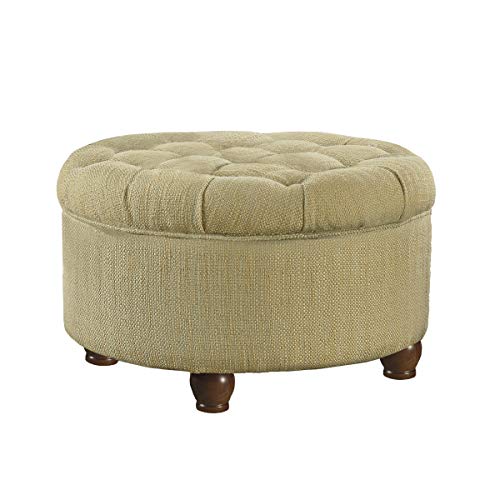
The HomePop is the premium ottoman pick and the most decorative framed option here. The round drum shape and button-tufted woven upholstery in a tan and cream tweed give it a tailored, traditional look that reads as a deliberate design piece rather than a utility box. At 25 inches across it has the widest top in this comparison, so it handles coffee-table duty with a tray comfortably, and the lid lifts to reveal storage inside for blankets or toys. It is the pick for a formal living room where the pouf’s casual slouch would look out of place.
Specs:
- Type: Ottoman (round storage drum)
- Dimensions: 25″D x 25″W x 15″H
- Shape: Round
- Seat height: 15 inches
- Upholstery: Button-tufted woven fabric, tan and cream tweed
- Storage: Yes, under the lid
- Model number: N8264-F1077
- Tier: Premium
4. LR Home Natural Round Pouf
The LR Home pouf is the mid-range pouf pick, a hand-woven jute round made in India. The striped natural jute shell brings the organic texture that boho, coastal, and Scandinavian rooms rely on, and at 20 inches wide it is broad enough to serve as a genuine extra seat, not just a footrest. The listing gives a maximum weight recommendation of 300 lb, the highest stated figure among the poufs here. At only 10 inches tall it sits low, which suits propping your feet up from a sofa or floor seating around a low table, but makes it the least suitable pick for anyone who finds getting up from low seats difficult.
Specs:
- Type: Pouf (round floor pouf)
- Dimensions: 20″D x 20″W x 10″H
- Cover: Hand-woven jute
- Frame material: Cotton
- Maximum weight recommendation: 300 lb
- Origin: Handmade in India
- Tier: Mid-range
5. REDEARTH Round Pouf Ottoman, Cable Knitted, Ivory

The REDEARTH is the budget pouf pick and the softest-looking piece in the comparison. Its hand-knitted cotton shell has a chunky cable pattern that reads like a sweater for your floor, and the bead fill gives it a firm but yielding sit. At 14 inches tall it stands higher than the LR Home pouf, so it works better as a perch for guests and in nurseries and kids’ rooms, the spaces the maker highlights. The ivory color suits light, neutral schemes, and care is spot clean only, worth knowing if it will live within reach of toddlers or pets.
Specs:
- Type: Pouf (round knitted pouf)
- Dimensions: 18″D x 18″W x 14″H
- Cover: Hand-knitted cotton, cable pattern
- Fill: EPS beads
- Seat height: 14 inches
- Model number: REAH07
- Care: Spot clean
- Tier: Budget
How to Choose Between an Ottoman and a Pouf
Start with storage. If the purchase is partly about hiding blankets, toys, or clutter, only an ottoman qualifies, so size the interior to what you plan to store and check the stated volume before buying.
Decide how it will be sat on. For daily adult seating or a coffee-table surface, the ottoman’s frame and flat top are the safer choice. For occasional seating, kids, and footrest duty, a pouf’s softness is a feature rather than a flaw.
Match the height to your sofa. Measure your sofa’s seat height. A footrest a little lower than the seat is comfortable for lounging, while a piece at seat height works better as a chair substitute. This is where low poufs around 10 inches tall can disappoint if you expected a seat.
Think about movement. If the piece will travel between rooms, go on a closet shelf, or serve in a nursery now and a living room later, the pouf’s light weight wins. If it will live in one spot as part of the furniture arrangement, the ottoman’s structure wins.
Match the material to the room. Woven jute and knitted cotton poufs add soft texture to relaxed schemes, while tufted or faux leather ottomans hold a more formal line. Also check care instructions against your household: wipeable faux leather suits homes with young children, while spot-clean-only knits ask for a calmer setting.
Who Should Skip Each One
Skip the ottoman if you need a seat you can carry from room to room, if your style leans soft and unstructured, or if you are furnishing a small space where a framed box would feel heavy. Skip the pouf if you need storage, if the piece will be your main extra seat for adults, if you want a stable surface for trays and laptops, or if anyone using it has trouble rising from a low, soft seat.
Frequently Asked Questions
Can you sit on a pouf, or is it only a footrest?
You can sit on most poufs, and the two in this comparison are sold as seats as well as footrests. Expect a softer, lower sit than a chair, because the fill shifts under you. For long sitting sessions or guests who need support, a framed ottoman is the better seat.
Do storage ottomans really hold much?
Yes, more than most buyers expect. The bench in this comparison states a 35-gallon interior, which covers spare bedding or several throw blankets, while a small 15-inch cube states 11 gallons, enough for remotes, magazines, and a folded throw. Check the stated volume in the specs rather than judging by outside dimensions.
Will a pouf lose its shape over time?
Bead and fiber fills can compress with daily use, so a heavily used pouf gradually sits lower and softer. Poufs with accessible fill can be topped up; sealed knitted styles like the REDEARTH above cannot, which is worth weighing if the pouf will be a primary seat rather than an occasional one.
Which is better for a small apartment?
It depends on the constraint. If storage is the problem, a storage ottoman replaces a separate blanket box and earns its footprint. If floor space is the problem, a pouf tucks beside or under furniture and moves out of the way in seconds, and a folding storage ottoman is a reasonable middle ground between the two.
Conclusion
Ottoman vs pouf is really frame vs fill. Choose an ottoman when you want structured seating, a flat coffee-table surface, and the only storage on offer: the SONGMICS bench for maximum capacity, the Mazie cube for a compact budget footrest, or the tufted HomePop drum for a formal room. Choose a pouf when you want light, movable, texture-rich comfort: the LR Home jute pouf for a wide, natural-fiber seat, or the knitted REDEARTH for a taller, softer perch. Match the piece to the job, the seat height to your sofa, and either style will earn its place in the room.