Key takeaways
- Five yoga mats compared across foam, TPE, PVC and natural rubber, with published thickness, size, grip and weight specs to help you pick the right one.
- Top Pick: Gaiam Essentials Thick Yoga Mat, 10 mm
- Runner-up: TOPLUS Upgraded Yoga Mat, 1/4 Inch
- Also consider: Manduka PROlite Yoga Mat, 4.7 mm
A good yoga mat does three jobs at once: it keeps hands and feet from sliding, it cushions knees, elbows and hips against the floor, and it stays flat and steady underfoot during standing poses. The five mats below cover the main material families on sale today, from thick foam and lightweight TPE to dense PVC and natural rubber, across budget, mid-range and premium tiers.
Every pick here is a dedicated yoga mat, and every figure in the Specs blocks comes from published listing and maker information: material, thickness, dimensions, weight and care instructions. Where a maker does not publish a figure, the Specs block says so rather than filling the gap with a guess.
As an Amazon Associate, we earn from qualifying purchases.
Quick answer
For most people, the Manduka PROlite is the balanced pick: 4.7 mm of dense PVC cushion at a carry-friendly weight. If your knees need maximum padding, the Gaiam Essentials Thick gives you 10 mm of foam. The JadeYoga Harmony offers natural rubber grip, the Manduka PRO is the dense buy-once option, and the TOPLUS is the lightweight budget TPE choice.
The five picks
Gaiam Essentials Thick Yoga Mat, 10 mm
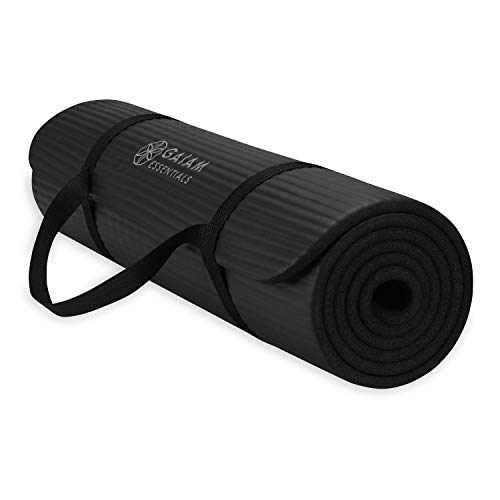
This is the cushion-first pick of the group. Gaiam builds the mat from high-density NBR foam at a full 10 mm thick, roughly double the padding of a standard studio mat, which takes pressure off knees, wrists, hips and spine during floor work and restorative poses. The surface carries textured ridges on both sides for traction, and the closed-cell foam resists moisture, so a simple wipe-down keeps it clean. At 72 inches long it suits taller practitioners, and the included easy-cinch strap means the rolled mat travels to class without unrolling. The trade-off is feel: very thick foam can feel less stable in balance poses, so flowing standing sequences are better served by a thinner mat below.
Specs
– Material: NBR (nitrile butadiene rubber) foam
– Thickness: 10 mm (2/5 inch)
– Dimensions: 72 x 24 inches
– Weight: 3.11 lbs
– Surface: Dual-sided textured ridges, closed-cell
– Included: Easy-cinch carrier strap
– Care: Hand wash only
TOPLUS Upgraded Yoga Mat, 1/4 Inch

The TOPLUS is the lightweight option for anyone carrying a mat to class several times a week. It is made from TPE, a thermoplastic elastomer, with no PVC, plasticizers or harmful dyes in the material, according to the maker. At 6 mm it lands in the middle ground: enough cushion for kneeling poses, thin enough to feel the floor in standing work. Both faces carry a non-slip texture, with the upgraded pattern on top aimed at grip for hands and feet. The mat is waterproof and wipes clean with a damp cloth. A carrying strap is included. The listing does not publish an item weight, so frequent travellers who count every ounce should note that gap before ordering.
Specs
– Material: TPE (thermoplastic elastomer)
– Thickness: 6 mm (1/4 inch)
– Dimensions: 72 x 24 inches
– Weight: Not stated
– Surface: Double-sided non-slip texture
– Included: Carrying strap
– Care: Hand wash only
Manduka PROlite Yoga Mat, 4.7 mm

The PROlite is Manduka’s lighter take on its studio PRO line, and the maker describes it as the mat most recommended by teachers in its range. The 4.7 mm of high-density PVC cushion gives firm, floor-like support that protects joints without the wobble of soft foam, and the closed-cell surface seals out moisture and sweat, which makes cleaning simple and keeps odours from soaking in. The standard size runs 71 x 24 inches, and longer and wider versions exist in the same line. Manduka publishes a weight of 4.6 lbs for the standard size, light enough for a daily commute to the studio. The PROlite carries the same lifetime guarantee as the PRO, and its PVC is certified to the OEKO-TEX Standard 100.
Specs
– Material: PVC, OEKO-TEX Standard 100 certified
– Thickness: 4.7 mm
– Dimensions: 71 x 24 inches
– Weight: 4.6 lbs
– Surface: Closed-cell, moisture-sealed
– Included: Not stated
– Care: Wipe clean (maker guidance)
JadeYoga Harmony Yoga Mat, 68 Inch

The Harmony is the natural rubber pick. JadeYoga makes it in the USA from rubber tapped from rubber trees, with no PVC, EVA or synthetic rubber in the construction. Natural rubber has an open-cell texture that grips hands and feet firmly, which is why this mat suits flowing and heated practices where palms tend to slide on smoother surfaces. At 3/16 inch thick and 24 inches wide, it balances cushion against a close feel for the floor, and the 68-inch length fits most heights, with longer lengths sold in the same line. Rubber is heavier than foam, and this mat weighs 4.2 lbs in the size listed. Care is hand washing only, and the maker plants a tree for every mat sold through its give-back program.
Specs
– Material: Natural rubber
– Thickness: 3/16 inch (0.19 inch)
– Dimensions: 68 x 24 inches
– Weight: 4.2 lbs
– Surface: Open-cell natural rubber texture
– Included: Mat only
– Care: Hand wash only
Manduka PRO Yoga Mat, 6 mm

The PRO is the heavyweight, buy-once end of this roundup. Six millimetres of ultra-dense PVC give it a firm, stable platform that Manduka backs with a lifetime guarantee, and the maker builds it in Germany from OEKO-TEX certified, latex-free PVC. The closed-cell top seals out moisture, while a dot pattern on the underside locks the mat to the floor so it does not creep during transitions. At 71 x 26 inches it is two inches wider than the other picks here, which helps in wide stances, and that extra material shows in the weight: 7.5 lbs. This is a mat to unroll at home and leave in place, rather than one to carry across town every day.
Specs
– Material: PVC, OEKO-TEX Standard 100 certified, latex free
– Thickness: 6 mm
– Dimensions: 71 x 26 inches
– Weight: 7.5 lbs
– Surface: Closed-cell top, dot-pattern underside
– Included: Not stated
– Care: Wipe clean (maker guidance)
How to choose
Thickness is the first decision. Mats around 4 to 5 mm give a firm connection to the floor and suit balance work and flowing sequences. Mats at 6 mm add joint protection for daily practice. Anything at 10 mm or above is built for comfort during floor-based and restorative sessions, and it will feel less steady in standing balances.
Material shapes grip and care. Natural rubber grips the most and feels planted, but it is heavy and needs hand washing. Dense PVC, as in the two Manduka picks, is the durability option, with closed-cell surfaces that wipe clean. TPE is light and free of PVC, a good middle path for commuting. NBR foam is the softest and thickest option here, aimed at cushion rather than precision.
Size and weight matter more than they seem. A 68-inch mat suits shorter practitioners; 71 and 72 inches give taller bodies room in reclined poses, and the 26-inch width of the Manduka PRO helps in wide stances. If the mat travels with you, keep the weight near or below 5 lbs. If it lives on your floor, extra weight is a benefit, because a heavy mat stays put.
Who should skip
Skip this roundup if you need a mat purely for high-impact gym work, weights or shoes-on training, since yoga mats are built for bare feet and bodyweight pressure, and general gym flooring suits that use better. Skip the thick foam picks if your practice is mostly standing balance work, and skip natural rubber if you have a latex sensitivity, since the JadeYoga Harmony is made from rubber tapped from trees. Anyone after a folding travel mat that fits inside a suitcase should look at dedicated travel lines instead, because every mat here rolls rather than folds.
FAQ
How thick should a yoga mat be?
For most practitioners, 4 to 6 mm is the working range: enough cushion for knees and elbows, with a stable feel in standing poses. Choose 10 mm or more only if floor work and joint comfort matter more to you than balance stability.
Which mat material grips best in a heated class?
Natural rubber, like the JadeYoga Harmony, has an open-cell surface that holds grip as hands get warm and damp. Dense PVC mats with closed-cell surfaces are easier to clean but can feel smoother, so many heated-class practitioners pair them with a mat towel.
Does mat weight matter?
It matters if you carry the mat. The picks here range from about 3 lbs to 7.5 lbs. A heavier mat stays in place and feels planted at home, while a lighter mat is far easier to take to a studio several times a week.
How do I clean a yoga mat?
Follow the care line in the Specs block. The foam, TPE and rubber picks here are hand wash or wipe clean only, and the closed-cell Manduka mats need just a wipe with a damp cloth. Let any mat dry fully before rolling it up.
Final verdict
Match the mat to the way you practise. The Manduka PROlite is the safest all-round choice for a mix of home and studio sessions. The Gaiam Essentials Thick is the comfort pick for sensitive joints, the TOPLUS keeps things light and simple on a budget, the JadeYoga Harmony delivers natural rubber grip for flowing and heated classes, and the Manduka PRO is the dense, wide, leave-it-unrolled option for a dedicated home practice space.