Our Short List of 3
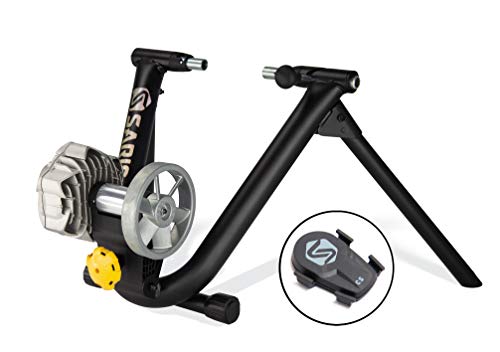
- Best for: A beginner who wants app-ready rides from day one without a smart trainer budget.
- Fluid resistance with progressive, road-like feel
- Included speed sensor connects with Rouvy, Zwift and other indoor cycling apps
- Includes one month subscription to Rouvy virtual training app
- Noise level: 69 decibels at 20 mph

- Best for: A beginner who wants guided intervals and virtual climbs with automatic resistance.
- Electromagnetic resistance provides a measured workout every time
- Connects to indoor cycling apps with dual ANT+ FE-C and Bluetooth
- Zwift certified
- Includes one month subscription to Rouvy virtual training app

- Best for: A beginner who wants quiet fluid resistance and a trainer that stores behind a door.
- Fluid resistance wheel for a smooth, quiet spin
- Fits bikes between 26 and 29 inches, and 700C wheels
- Heavy-duty stainless steel frame
- Dual locking system locks the bike in place
All 4 Picks at a Glance
| Product | Specs | Action |
|---|---|---|
| Saris Fluid2 Smart Equipped |
| Check price on Amazon |
| Saris M2 Smart |
| Check price on Amazon |
| Sportneer Fluid |
| Check price on Amazon |
 Sportneer Magnetic |
| Check price on Amazon |
Key takeaways
- The best bike trainers for beginners under 500 dollars: 4 wheel-on picks with fluid, magnetic and smart resistance for road and mountain bikes.
A first indoor trainer forces a real choice: spend on a smart unit that changes resistance for you, or save money on a simple wheel-on stand and ride with your own effort. Beginners often assume the smart option is the only serious one, then discover the setup, the app subscription and the axle adapters that come with it. The truth is simpler. A well built wheel-on trainer gives a new rider steady resistance, a natural road feel and a session that starts in minutes, and every model in this guide stays inside the ceiling in the keyword.
This guide is for riders buying their first trainer for winter miles, base fitness or a first structured plan, on a road or mountain bike they already own. The four trainers below were chosen from names and specifications on their Amazon product pages, covering fluid resistance, manual magnetic resistance and one smart electromagnetic unit, so a beginner can match the trainer to how they actually plan to ride.
Quick Picks
As an Amazon Associate we earn from qualifying purchases
| Product | Best for | Key spec from title |
|---|---|---|
| Saris Fluid2 Smart Equipped | A first trainer with app-ready speed data | Fluid resistance with included speed sensor |
| Saris M2 Smart | Structured app workouts with automatic resistance | Electromagnetic smart resistance, ANT+ and Bluetooth |
| Sportneer Fluid | Quiet fluid rides in a shared home | Fluid resistance, folds for storage |
| Sportneer Magnetic | The simplest start with manual control | 6-level magnetic resistance, bar-mounted remote |
How to Choose
Resistance type decides the ride feel
Fluid resistance grows harder as you pedal faster, which feels close to riding outside and suits steady endurance sessions. Magnetic resistance changes in fixed steps through a handlebar lever, so a beginner can pick a level and hold it without thinking about speed. Smart electromagnetic resistance lets an app change the load for you during a workout or a virtual climb. A new rider who mostly wants to spin for fitness will be happy with fluid or magnetic, while someone who wants guided intervals should look at the smart option first.
Wheel-on trainers suit beginners best
Every trainer in this guide is wheel-on, which means the rear wheel stays on the bike and presses against a roller. Setup takes minutes, the bike comes off the stand just as fast, and there is no cassette to buy or fit. Direct-drive trainers remove the rear wheel and connect the chain to the unit, which gives a quieter ride and more accurate power, but they cost more, need a cassette and a compatible axle, and often sit above the ceiling in this guide. For a first trainer, wheel-on is the practical starting point.
App compatibility needs a sensor or a smart unit
Apps such as Zwift and Rouvy need speed or power data to move an avatar or follow a workout. A non-smart trainer can still work with apps when it carries a speed sensor, as the Saris Fluid2 Smart Equipped does, because the app estimates power from speed. A smart trainer such as the Saris M2 sends power directly and changes resistance on its own. Before buying, check whether the trainer includes a sensor, whether it speaks ANT+ and Bluetooth, and whether the app you want supports the model.
Fit, footprint and noise matter every day
Check the wheel sizes a trainer accepts, because most wheel-on units fit 26 to 29 inch wheels and 700C, while smaller wheels need an adapter. Bikes with thru-axles often need a separate adapter, while quick-release bikes usually mount straight away. Folding frames and a front wheel riser block make storage and levelling easier in a small room. Noise matters too: the Saris models in this guide are rated at 69 decibels at 20 miles per hour, which is a normal conversation level, while magnetic units are generally quieter than fluid ones at high speed.
The 4 Best Options
Saris Fluid2 Smart Equipped
- Best for: A beginner who wants app-ready rides from day one without a smart trainer budget.
- Fluid resistance with progressive, road-like feel
- Included speed sensor connects with Rouvy, Zwift and other indoor cycling apps
- Includes one month subscription to Rouvy virtual training app
- Noise level: 69 decibels at 20 mph
A beginner who wants app-ready rides from day one without a smart trainer budget.
Resistance is progressive only, so the trainer cannot change load for a structured interval on its own.
The Fluid2 Smart Equipped is the most complete first trainer in this guide, because it pairs the long-running Fluid2 frame with a speed sensor that connects the ride to training apps. Fluid resistance rises smoothly with pedalling speed, so steady rides feel natural and there are no levels to fiddle with. The sensor talks to Rouvy, Zwift and other indoor cycling apps, and a one month Rouvy subscription is included, which gives a beginner a guided way to start without buying extra hardware.
Saris M2 Smart
- Best for: A beginner who wants guided intervals and virtual climbs with automatic resistance.
- Electromagnetic resistance provides a measured workout every time
- Connects to indoor cycling apps with dual ANT+ FE-C and Bluetooth
- Zwift certified
- Includes one month subscription to Rouvy virtual training app
A beginner who wants guided intervals and virtual climbs with automatic resistance.
The listing gives two different power accuracy figures, so confirm the expected accuracy with the seller before buying.
The M2 Smart is the only trainer in this guide that changes resistance by itself, which makes it the natural pick for a beginner who wants structured workouts. Its electromagnetic unit follows the workout or the virtual road, so climbs feel harder and recoveries feel easier without touching a lever. Dual ANT+ FE-C and Bluetooth keep it connected to Zwift and other apps, and the built-in power feedback means there is no need for a separate meter to track effort.
Sportneer Fluid
- Best for: A beginner who wants quiet fluid resistance and a trainer that stores behind a door.
- Fluid resistance wheel for a smooth, quiet spin
- Fits bikes between 26 and 29 inches, and 700C wheels
- Heavy-duty stainless steel frame
- Dual locking system locks the bike in place
A beginner who wants quiet fluid resistance and a trainer that stores behind a door.
There is no speed sensor or app connection, so a separate sensor is needed for virtual riding.
The Sportneer Fluid is a straightforward fluid trainer that suits a beginner who values a quiet ride and a frame that folds away after the session. Fluid resistance rises with pedalling speed, so there are no levels to learn and the ride stays smooth from warm-up to cool-down. The stainless steel frame and dual locking system hold the bike firmly, and the extra-wide base keeps the unit steady during harder efforts, which matters for a rider still building confidence indoors.
Sportneer Magnetic
- Best for: A beginner who wants the lowest-fuss start with manual resistance control.
- 6-level magnetic resistance adjustment with bar-mounted remote control
- Magnetic wheel design reduces friction for a quiet, smooth ride
- Fits 26 to 28 inch and 700C wheels
- Includes 1 bicycle trainer stand, 1 resistance remote, 1 front wheel block and 1 skewer
A beginner who wants the lowest-fuss start with manual resistance control.
Resistance tops out sooner than on the fluid models, so strong sprinters may outgrow it.
The Sportneer Magnetic is the simplest trainer in this guide, and that is exactly its strength for a new rider. Six magnetic resistance levels change through a bar-mounted remote, so effort can be adjusted without getting off the bike. The magnetic wheel keeps noise low, the frame folds for storage, and the kit includes a front wheel riser block and a quick-release skewer, so most road and mountain bikes mount with nothing extra to buy.
Which One Fits Your Situation
You want the simplest first trainer that just works
Pick the Sportneer Magnetic. Six levels on a handlebar remote are easy to learn, the kit includes the riser block and skewer, and the frame folds away when the session ends. It is the least demanding trainer in this guide to set up and ride.
You want structured app workouts with resistance that changes for you
Pick the Saris M2 Smart. It is the only model here that follows a workout or a virtual climb on its own, and it sends power data straight to the app. A beginner who plans to follow training plans will get more from it than from any manual trainer.
You want the quietest ride in a shared home
Pick the Sportneer Fluid. Its fluid wheel spins smoothly with little mechanical noise, the frame is solid and wide, and there is no fan or motor to add sound. Pair it with a trainer tire to keep the roller quiet at higher speeds.
You want app rides without paying for a smart trainer
Pick the Saris Fluid2 Smart Equipped. The included speed sensor connects the ride to Zwift and Rouvy, the fluid resistance feels natural, and the foldable frame stores easily. It gives a beginner the app experience with a simple mechanical trainer underneath.
Common Mistakes
- Buying a direct-drive trainer without checking cassette and axle compatibility, then discovering extra parts are needed before the first ride.
- Riding a knobby mountain bike tire on the roller, which is loud, wears fast and slips under effort.
- Skipping the front wheel riser block, which leaves the bike tilted and the riding position wrong.
- Assuming every trainer fits a thru-axle bike, when many need a separate adapter for that axle type.
- Expecting a non-smart trainer to change resistance inside an app, when only a smart unit or a speed sensor setup can do that.
Frequently Asked Questions
Do I need a special tire for an indoor trainer?
A trainer-specific tire is worth buying because road tires wear quickly on a roller and knobby mountain bike tires are loud and can slip. A smooth trainer tire grips the roller better, lasts far longer and keeps noise down, which matters in a shared home.
Will these trainers work with a thru-axle bike?
Most wheel-on trainers are built around quick-release axles, so a thru-axle bike usually needs a separate adapter from the trainer maker or a third party. Check the axle size and thread pitch of the bike before ordering, and confirm the adapter fits the trainer model.
Can I use Zwift with a non-smart trainer?
Yes, when the trainer carries a speed sensor or one is added separately. The app estimates power from wheel speed, so the avatar moves and workouts can be followed. Only a smart trainer changes resistance automatically to match hills or intervals.
How loud are these trainers?
The Saris models in this guide are rated at 69 decibels at 20 miles per hour, which is about the level of a normal conversation. Magnetic trainers are generally quieter than fluid ones at high speed, and a smooth trainer tire plus a mat under the unit will lower the noise further.