Key takeaways
- Compare five camping stoves across propane, canister, liquid fuel and wood, with boil times, burn times, weights and fuel details for every pick.
- Top Pick: Coleman Classic Propane Stove, 2 Burner
- Runner-up: MSR PocketRocket 2
- Also consider: Jetboil Flash Cooking System
A camping stove has one job: turn fuel into a hot meal wherever you pitch. The five stoves below cover the four fuel families campers actually use, from a two-burner propane tabletop for family basecamps to a palm-sized canister burner for solo trails and a wood model that runs on gathered twigs.
Each pick is described from its published specifications, so the boil times, burn times, weights and fuel figures quoted here come straight from the makers and their listings. Match the fuel type and burner size to the way you travel, and the right stove usually picks itself.
As an Amazon Associate, we earn from qualifying purchases.
Quick answer
For most campers, the Coleman Classic Propane Stove is the easy answer: two burners, room for two 10-inch pans and a full hour of cooking from one small propane cylinder. Backpackers should look at the featherweight MSR PocketRocket 2 or the fast-boiling Jetboil Flash, while the MSR WhisperLite and Solo Stove Lite cover liquid fuel and wood.
The picks
Coleman Classic Propane Stove, 2 Burner
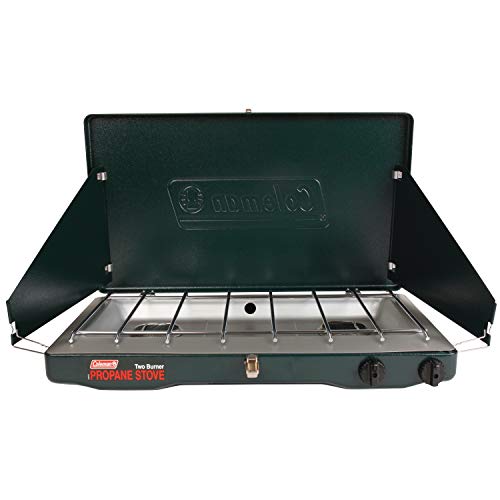
The Classic is the tabletop workhorse of campground cooking. Two adjustable burners deliver 20,000 total BTU under a cooking surface wide enough for two 10-inch pans side by side, and the WindBlock side panels shield the flames on breezy pitches, then fold down as extra side space. Coleman’s PerfectFlow regulator keeps the output steady as the cylinder empties, which makes simmering far more predictable than on an unregulated burner.
It runs on the familiar 16.4 ounce propane cylinder and gives up to an hour of cooking on high from a single cylinder. Lighting is by match, and the whole unit folds flat with the regulator stored inside, so it rides in a trunk or a camp kitchen box without fuss. This is the mid-range anchor for car camping and group breakfasts rather than trail miles.
Specs
– Fuel: Propane, 16.4 oz cylinder (sold separately)
– Burners: 2, adjustable
– Output: 20,000 total BTU
– Cooking surface: Fits two 10 in pans side by side
– Wind protection: WindBlock side panels
– Runtime: Up to 1 hour on high per cylinder
– Ignition: Match lighting
– Dimensions: 21.9 x 13.7 x 4.1 in
– Model: 2000020943NP
MSR PocketRocket 2

The PocketRocket 2 is the canister stove stripped to the essentials. It weighs 2.6 ounces, folds down small enough to nest inside a cook pot, and still boils a liter of water in 3.5 minutes. The serrated pot supports fold out to grip a pan securely and fold back in seconds, and a hard case is included for protection in the pack.
A 227 gram isobutane-propane canister gives about 60 minutes of burn time and boils up to 16 liters of water, which covers a long weekend of drinks and dehydrated meals for one or two walkers. There is no built-in igniter, so a lighter or matches ride along, and the open burner design rewards a sheltered pitch in wind. This is the budget-to-mid-range trail pick for walkers who count every gram.
Specs
– Fuel: Isobutane-propane canister (sold separately)
– Weight: 2.6 oz (73 g); 4.2 oz in case
– Boil time: 3.5 minutes per liter
– Burn time: 60 minutes per 227 g canister
– Water boiled: 16 liters per 227 g canister
– Ignition: None built in
– Includes: Hard case
– Part number: 09884
Jetboil Flash Cooking System

The Flash is an integrated system built around one task: boiling water fast. The burner locks directly onto a 1.0 liter FluxRing cup, and the published boil time is 100 seconds for half a liter. An insulating cozy wraps the cup, and a color-change heat indicator on the side shows when the water is hot without lifting the lid.
A pushbutton igniter lights the burner without matches, and a 100 gram fuel canister nests inside the cup with the included stabilizer for a single compact package. The drink-through lid and the bottom cover, which doubles as a measuring cup and bowl, complete a tidy solo or two-person kit. Simmering range is limited, so this premium system suits boil-only menus of drinks, noodles and pouch meals.
Specs
– Fuel: JetPower isobutane-propane canister (sold separately)
– Cup: 1.0 liter FluxRing with insulating cozy
– Boil time: 100 seconds per 0.5 liter
– Output: 9,000 BTU per hour
– Weight: 13.1 oz (371 g)
– Ignition: Pushbutton
– Includes: Fuel canister stabilizer, drink-through lid
– Model: 1097714
MSR WhisperLite

The WhisperLite is the liquid-fuel classic, in production for decades and still the reference point for cold-weather and expedition cooking. It burns white gas from a refillable fuel bottle pressurized by the included pump, a setup that keeps full output in freezing temperatures and at altitude, where canister stoves fade. MSR rates it at 3.9 minutes to boil a liter and 136 minutes of burn time from 600 milliliters of fuel.
The self-cleaning Shaker Jet clears the fuel line with a shake, and the wide pot supports handle group-sized pans with confidence. Flame control is coarser than a canister valve, and the fuel bottle is sold separately. The box carries the fuel pump, windscreen, heat reflector, small-parts kit and stuff sack. This is the premium pick for winter trips, high routes and travel where canisters are hard to find.
Specs
– Fuel: White gas (fuel bottle sold separately)
– Minimum weight: 11.5 oz (326 g)
– Packed weight: 15.2 oz (431 g)
– Boil time: 3.9 minutes per liter
– Burn time: 136 minutes per 600 ml of fuel
– Jet: Self-cleaning Shaker Jet
– Includes: Fuel pump, windscreen, heat reflector, small-parts kit, stuff sack
– Model: 14098
Solo Stove Lite

The Lite burns what the campsite provides: twigs, pine cones and other gathered biomass. Its double-wall body draws air through the base and feeds it back in at the top for secondary combustion, so the fire burns hot with very little smoke. At 9 ounces, with a packed height of 3.8 inches, it disappears into a pack corner and never needs a fuel canister.
The nichrome wire cooking ring sits on top for a pot, then flips over to nest inside the body for travel. Solo Stove rates the boil at 8 to 10 minutes for 32 ounces of water, slower than gas but with an endless fuel supply where dry wood is plentiful. This mid-range pick suits campers who like a real flame and want to leave canisters behind, where fire rules allow one.
Specs
– Fuel: Twigs and gathered biomass
– Material: 304 stainless steel, nichrome wire cooking ring
– Weight: 9 oz (255 g)
– Diameter: 4.25 in
– Height: 5.7 in assembled, 3.8 in packed
– Boil time: 8 to 10 minutes for 32 fl oz
– Design: Double-wall gasifier with secondary combustion
– Model: SS1-FBA
How to choose
Fuel first. Propane cylinders and isobutane-propane canisters are the simplest to use and the easiest to find in camp shops. White gas asks more of the cook, with priming and a pump, but it is refillable, works in deep cold and is sold almost everywhere in the world. Wood adds nothing to the pack weight and needs no canister, yet it depends on dry fuel at camp and on local fire rules.
Match the burner to the menu. Boiling water for drinks and pouch meals favors a fast, narrow burner or an integrated system. Real cooking with wide pans and gentle simmering favors a two-burner tabletop or a stove with wide pot supports and fine flame control.
Weigh the whole system. A stove’s own weight is only part of the load: add the fuel container, the pot it needs and any windscreen. Ultralight walkers feel every ounce, while car campers can trade weight for stability and cooking space.
Plan for wind and cold. Open burners lose heat fast in a breeze, so a sheltered pitch or folding wind panels matter. In freezing weather, liquid fuel and inverted-canister designs hold their output long after an upright canister stove has faded.
Who should skip
Skip this roundup if your outdoor cooking happens in the garden: a fire pit or a grill is the better tool there, and those families are covered elsewhere on this site. Campervan and RV owners with a fitted hob gain little from a portable stove beyond a backup. Anyone camping under a seasonal open-flame ban should leave the wood stove at home and choose a gas model with a shut-off valve, and walkers who eat cold food on trail can skip the stove weight entirely.
FAQ
Which camping stove fuel is easiest to find on the road?
Propane and isobutane-propane canisters are stocked by most camp shops and outdoor retailers, so they are the easiest fuels to replace mid-trip. White gas is sold in hardware and outdoor stores worldwide under local names, which makes the liquid-fuel stove the safer pick for remote or international travel.
Can a small canister stove simmer, or is it only good for boiling?
Most canister stoves simmer well enough for sauces and grains, because the valve meters fuel in fine steps. Integrated systems such as the Flash are tuned for full-power boiling and offer a narrower simmering range, so frequent cooks should choose an open burner design instead.
How long does one small fuel canister last on a weekend trip?
A 227 gram canister gives roughly 60 minutes of burn time on a stove like the PocketRocket 2, which covers two or three days of morning drinks and evening meals for one or two people. Wind, cold and large pots shorten that figure, so winter trips call for a spare.
Are wood-burning camp stoves allowed at every campsite?
No. Many sites and land managers restrict or ban open flames during dry periods, and some allow only stoves with a fuel shut-off valve. A twig stove counts as an open fire in most rule books, so check the local rules before relying on one as your only cooker.
Final verdict
For car camping and group cooking, the Coleman Classic Propane Stove remains the sensible default: two burners, honest output and fuel you can buy anywhere. On the trail, the MSR PocketRocket 2 is the light and simple canister pick, while the Jetboil Flash earns its premium tier if your menu is mostly boiled water. The MSR WhisperLite is the one to trust in cold weather and far from canister supplies, and the Solo Stove Lite is the characterful wood-burning option where fires are allowed. Pick by fuel and menu first, and any of the five will cook reliably for years.