Key takeaways
- Compare the best trekking poles for hiking, backpacking and travel, from carbon fiber and aluminum telescoping pairs to a compact tri-fold design.
- Top Pick: Cascade Mountain Tech Carbon Fiber Quick Lock Trekking Poles
- Runner-up: TrailBuddy Trekking Poles
- Also consider: TREKOLOGY Trek-Z Cork Grip Trekking Poles
A pair of trekking poles earns its place in a pack on the descents. Poles plant ahead of your boots on loose gravel, share the load with your arms on long climbs, and give you two extra points of contact when a stream crossing or a muddy bank turns slick. They also double as shelter supports, since many tarps and ultralight tents pitch around a pair of adjustable poles instead of dedicated tent poles.
This roundup compares five pairs across the main buying decisions: carbon fiber or aluminum shafts, telescoping or tri-fold designs, lever locks or flip locks, and cork or foam grips. Every pick is sold as a pair, adjusts without tools, and comes with the tips or baskets its maker lists for mixed terrain. They run from a budget aluminum pair to a premium carbon set, with a folding travel option in between.
As an Amazon Associate, we earn from qualifying purchases.
Quick answer
For most hikers, the Cascade Mountain Tech Carbon Fiber Quick Lock pair is the sweet spot: light carbon shafts, glove-friendly locks and cork grips. TrailBuddy covers the budget tier in aluminum, the TREKOLOGY Trek-Z folds smallest for travel, Hiker Hunger is the lightest pair here, and the Black Diamond Trail Back is the heavy-duty aluminum option.
The picks
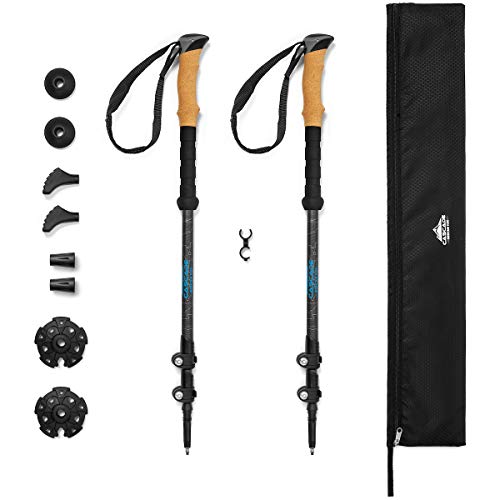
Cascade Mountain Tech Carbon Fiber Quick Lock Trekking Poles
Specs
– Shaft: Carbon fiber
– Adjustment: 26 to 54 in, quick locks
– Grip: Cork
– Weight: 8.1 oz per pole
– Collapsed length: 26 in
– Sold as: Pair, with storage bag and interchangeable tips
This is the mid-range pair most hikers will get along with best. The carbon fiber shafts keep each pole light and soak up some of the buzz that hard trails send through aluminum, while the quick locks open and close with gloves on, so length changes on a climb take seconds. Cork grips suit bare hands in warm weather, and the 26 to 54 inch range covers most heights as well as the taller settings a tarp or trekking-pole tent needs at camp. A storage bag and interchangeable tips come in the box, which keeps the pair tidy in a car boot or gear cupboard between trips.
TrailBuddy Trekking Poles

Specs
– Shaft: 7075 aluminum
– Adjustment: 24.5 to 54 in, lever locks
– Grip: Cork, with padded straps
– Weight: 9.7 oz per pole
– Tips: Tungsten carbide
– Included: Mud baskets, snow baskets, rubber tips, nylon carry bag
TrailBuddy is the budget-tier pick, built around aircraft-grade 7075 aluminum shafts that shrug off the knocks a first pair tends to collect. The lever locks work one-handed and hold the chosen length from 24.5 inches collapsed to 54 inches extended, a range that also suits shorter hikers and younger walkers. Cork handles pair with padded straps, the tungsten carbide tips bite on rock and dirt, and the threaded tip fittings keep the included baskets and rubber tips attached in mud and snow. Few pairs at this tier include the full accessory bundle, so the set arrives ready for year-round use.
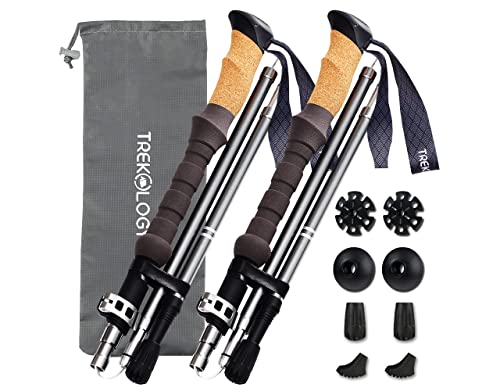
TREKOLOGY Trek-Z Cork Grip Trekking Poles
Specs
– Shaft: Aircraft-grade aluminum
– Design: Tri-fold, folds to 15 in (38 cm)
– Sizes: 100 to 120 cm and 115 to 135 cm
– Grip: Cork
– Weight: Under 11.5 oz per pole
– Included: Carry bag, rubber tips, mud stops, snow baskets, rubber feet
The Trek-Z is the travel pick. Its tri-fold shafts fold down to 15 inches, short enough to disappear inside a daypack or suitcase rather than strapping to the outside, and the sections snap together quickly when the trail begins. Two sizes cover most heights, and because a folding pole has a narrower adjustment window than a telescoping one, matching the size to your height matters more here. Cork grips, a carry bag and a full set of tips, mud stops and snow baskets come included. For fly-and-hike trips, city breaks with hill days, and anyone short on storage space, this is the easiest pair to live with.
Hiker Hunger Outfitters Carbon Fiber Trekking Poles

Specs
– Shaft: Carbon fiber
– Adjustment: 24 to 55 in, flip locks
– Grip: Cork, with EVA foam extension
– Weight: 7.6 oz per pole
– Collapsed length: 21 in
– Included: Carry bag, mud baskets, snow baskets, rubber tips, rubber feet
At 7.6 ounces per pole, the Hiker Hunger pair is the lightest in this roundup, and that gap grows more noticeable with every hour on the trail. The full carbon fiber shafts adjust from 24 to 55 inches on metal flip locks, the widest range here, so the same pair suits shorter and taller hikers and pitches high at camp. Cork grips sit above EVA foam extensions, giving a lower hold for steep climbs without shortening the pole. Carbon asks for a little more care than aluminum, since a hard sideways strike against rock can crack a shaft, but careful handlers get a premium pair that disappears in the hand.
Black Diamond Trail Back Trekking Poles

Specs
– Shaft: 7075 aluminum, 3-section
– Usable length: 100 to 140 cm, dual FlickLock levers
– Grip: EVA foam, with extension
– Weight: 522 g per pair (manufacturer figure)
– Collapsed length: About 62 cm
– Tips: Carbide, with interchangeable baskets
The Trail Back is the heavy-duty aluminum option, a three-section pair from a brand whose poles see regular use with guiding outfits. Dual FlickLock levers clamp the 7075 aluminum shafts across a 100 to 140 cm usable range, the EVA foam grips carry an extension for choking down on climbs, and the carbide tips take interchangeable baskets, including snow baskets for winter routes. At 522 grams a pair it gives away weight to the carbon picks, and the collapsed length is bulkier than the tri-fold design, but the trade buys a simple, robust pair that suits loaded backpacking and shelter pitching season after season.
How to choose
Shaft material sets the tone. Carbon fiber is lighter and calms vibration on hard ground, but it can crack under a hard sideways blow. Aluminum weighs a little more, bends rather than snapping, and shrugs off knocks against rock, which is why it fills the budget tier.
Design decides packed size. Telescoping pairs collapse to roughly 24 to 26 inches and offer the widest length range, while a tri-fold pair folds to about 15 inches and fits inside a pack, with a narrower sizing window as the trade-off. If the poles will pitch your shelter, check that their range covers the height your tarp or tent needs.
Locks and grips are daily-use details. Lever and flip locks adjust with gloves on and are simple to re-tension, and cork grips wick moisture and suit warm hands, while EVA foam stays light and works well with gloves. An extension below the main grip helps on steep ground. Finally, match the tips to the terrain: carbide for rock and dirt, rubber tips for pavement, and baskets to keep poles from sinking in snow or soft mud.
Who should skip
Walkers who stick to flat, paved routes will likely leave poles in the cupboard, since the benefits show up on climbs, descents and rough ground. Anyone shopping for support after an injury or for balance help around the home should look at dedicated mobility aids instead, because trekking poles are trail gear rather than medical equipment. And minimalists who already move happily with a single staff, or with none, will not miss a pair.
FAQ
What length should I set my trekking poles to?
A common guide is to set the pole so your elbow sits near a right angle with the tip on flat ground. Shorten the pair a little for steep climbs and lengthen it for descents, and use the height marks printed on the shafts to keep both sides even.
Carbon fiber or aluminum: which shaft material is better?
Neither wins outright. Carbon fiber is lighter and better at calming trail vibration, which suits long distances and gram counting. Aluminum is heavier but tougher against knocks and usually fills the budget tier, so it suits new hikers and anyone rough on gear.
Can I take trekking poles in carry-on luggage?
Rules differ between airlines and security screeners, and many hikers pack poles in checked baggage to be safe. A tri-fold pair helps either way, since it folds short enough to sit inside a suitcase or pack instead of strapped outside, where tips and baskets are easier to protect.
Why do hikers use two poles instead of one?
Two poles give a point of contact on each side, which steadies balance on uneven ground and stream crossings, spreads effort between both arms on climbs, and sets a rhythm that many walkers find easier to hold over long distances than a single staff.
Final verdict
Pick by the trips you actually take. The Cascade Mountain Tech pair is the all-round mid-range choice, TrailBuddy covers the budget tier with a generous accessory bundle, and the TREKOLOGY Trek-Z folds smallest for travel. Hiker Hunger wins on pure lightness, while the Black Diamond Trail Back is the robust aluminum pair for heavy loads and hard use.